Below The Fold ...

1780603699407.png
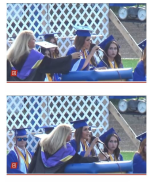
These are the closing words that Leen Hijaz, the valedictorian at Clayton High School in North Carolina, uttered that led her principal to pull her away from the microphone by the arm, cutting off her graduation speech:

"Class of 2026, this is our moment. Let's move forward with confidence, ambition, and hope for the future. Before I leave the stage, I have one last thing to say. Every single person here has a voice, and we are privileged to have the freedom to use it when so many people around the world are struggling and suffering to be heard. Whether it’s the millions suffering in Palestine, Sudan, Congo, Afghanistan and so many other countries around the world, or families being torn apart by ICE. These are not distant issues. They are happening right here as I speak. My point is, we’re not given a voice to stay silent."

After Leen refused to stay silent last Thursday, the school withheld her diploma -- then, this week, as the video spread and the questions mounted, reversed course and handed it over. Leen had left those closing lines out of her approved remarks, knowing they would never be cleared. She said them anyway.

"Somebody has to say something," she later explained, "because nobody else is going to speak up... so if you're given the opportunity, you should."

Kudos to Leen for showing the moral courage to use her voice for the voiceless. May we all find the same courage in these times.

You can watch Leen's graduation speech at https://youtu.be/MTNoGzVePhE?t=3662

For a powerful book for adult readers about summoning moral courage in the moments that matter most -- the decision to speak when silence would be easier -- we highly recommend Bishop Mariann Edgar Budde's "How We Learn to Be Brave: Decisive Moments in Life and Faith" at https://bookshop.org/a/8011/9780593539217 (Bookshop) and https://amzn.to/40GpHtM (Amazon)

It was also released in a young readers edition for tweens and teens, ages 10 and up: "We Can Be Brave: How We Learn to Be Brave in Life's Decisive Moments" at https://bookshop.org/a/8011/9798217113828 (Bookshop) and https://amzn.to/3L6lRGk (Amazon)

For an inspiring picture book encouraging girls to make their voices heard, we recommend "Raise Your Hand" for ages 5 to 9 at https://www.amightygirl.com/raise-your-hand

For two excellent resources to help tween and teen girls learn how to assert themselves with confidence and let their voices be heard, we highly recommend "A Smart Girl’s Guide to Knowing What to Say" for ages 9 to 12 (https://www.amightygirl.com/a-smart-girl-s-guide-to...) and "Express Yourself: A Teen
Girl's Guide to Speaking Up and Being Who You Are" for ages 12 and up (https://www.amightygirl.com/express-yourself-guide)

To inspire children and teens with the true stories of girls and women who dared to fight for change throughout history, visit our blog post, "Dissent Is Patriotic: 50 Books About Women Who Fought for Change," at https://www.amightygirl.com/blog?p=14364

SOURCE with comments
 
1780657674570.png

Detroit called her the Dragon Lady.
She took that as a compliment.
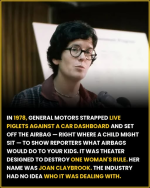
Joan Claybrook had started in 1966, twenty-nine years old, walking the halls of Capitol Hill alongside a young lawyer named Ralph Nader, whose book had just exposed American cars as death traps by design. The auto industry's response to Nader tells you everything: General Motors hired private investigators to tail him, dig up compromising information, and discredit him. They were caught so thoroughly that GM's president was called before Congress to issue a public apology. That same year, Claybrook helped push through the Motor Vehicle Safety Act — the first federal auto safety law in American history.
She had been in this fight for eleven years when President Carter put her in charge of the National Highway Traffic Safety Administration in 1977. She was the first woman ever to run the agency. She walked in and set the agenda on day one.
Mandatory crash tests. Safer school buses. The retractable stop sign that swings out to halt traffic when kids board and exit a bus — that was hers. And the big one: a rule requiring every new car to come equipped with automatic occupant protection. Airbags in every American car.
Detroit went to war.
Lawsuits. Congressional hearings. Executives flying to Washington to testify against her. Ford's Lee Iacocca had spent years fighting airbag requirements, lobbying Presidents to delay and kill the rule. And then General Motors made their piglet demonstration.
In 1978, GM made a show of strapping live piglets directly against the dashboard — where the airbag deploys with maximum force, where no human being would ever actually sit in a moving vehicle — and setting off the bag. The message to parents: see what this does to living things? See what Claybrook's rule would do to your child?
It was deliberate deception, and Joan Claybrook knew it immediately.
She issued the airbag rule anyway.
Then, in November 1980, Ronald Reagan won the presidency. Claybrook was out in January 1981. By October of that year, Reagan's new NHTSA administrator had rescinded her airbag rule — erasing over a decade of work in nine months because the industry wanted it gone.
So she sued.
Consumer groups, insurance companies, and public advocates took it to the Supreme Court. In 1983, in Motor Vehicle Manufacturers Association v. State Farm, the Court ruled that the Reagan administration had acted illegally. You cannot simply rescind a safety regulation because the industry finds it inconvenient. The airbag rule came back.
It still took until 1991 for Congress to mandate airbags by law, and until the 1998 model year before every passenger vehicle rolling off an American assembly line was required to have one. Joan Claybrook had been fighting for this for twenty-five years.
Here is what twenty-five years of fighting bought.
NHTSA's own estimates show that federal vehicle safety standards prevented more than 860,000 American deaths between 1968 and 2019. Airbags alone reduce fatalities in frontal crashes by approximately 31 percent. Around 40,000 lives saved every year. Rules she helped write, fought to defend, and watched get implemented over a career that has never stopped.
She never got rich doing it. She took public-interest wages her whole career and turned down the corporate consulting work that would have made her wealthy. She just kept showing up.
She has testified before Congress about Takata's exploding airbags, Toyota's sudden acceleration problem, Tesla's autopilot safety claims, and the dangers of autonomous vehicles. At eighty-three, she signed an open letter to her old agency telling them to do more. At eighty-eight, she is still alive, still angry, and still right.
Think about what that means.
Your parents may have walked away from a crash because of her. Your children ride safer because of her. The airbag that has been quietly riding shotgun in every car you've ever been in — waiting to save your life at 200 miles per hour in the fraction of a second it takes a collision to occur — is there because one woman refused to accept that the auto industry's profits mattered more than the lives of the people inside their cars.
GM strapped piglets to a dashboard to stop her.
She won anyway.

SOURCE
 
"a young lawyer named Ralph Nader" #322
(n)❗
"No Nader, no [the younger President] Bush." Professor Tim Burns / Colgate U.
Nader split the Dem. Florida vote, resulting in SCOTUS ruling for Bush in Bush v. Gore, resulting in Governor Bush [R-TX] being inaugurated president.

"The airbag that has been quietly riding shotgun in every car you've ever been in — waiting to save your life at 200 miles per hour in the fraction of a second it takes a collision to occur — is there because one woman refused to accept that the auto industry's profits mattered more than the lives of the people inside their cars." #322
😲
- piffle -

Seatbelts were the thin edge of the wedge.
Mandatory airbags the predictable result.
Takata the consequence.

ref:
Strasbourg Test
Draise Test
 
I do not like airbags.
They are very complicated, with fragile sensors and explosive inflators.
And what VW testing proved, is that padded restraints that moved with the door or by hand, are vastly superior and cheaper.
A knee bar was the most successful, but extending the dashboard padding is also successful.
Explosive airbags almost always fail since there is almost always more than one impact in an accident.
 
Last edited:
"I do not like airbags." R5 #324
R5 for president !

I'm not wild about having explosives mandated inside my car.

I understand, requiring school children to be vaccinated promotes herd immunity, at least in theory.

But if an individual voting taxpayer prefers the risks of no airbag to the risks of airbag,
U.S. government/s should not be authoritarian enough to impose it against the citizen's will.
 
Back
Top