The war in Iran (or whose war is it anyways?)

"That seems to be more of a discussion on why the political wind in the US was against Castro.
But I am just dealing with the question of how it could have been considered legal to impose economic sanctions on Cuba?" R5 #180
You make an insightful distinction here.
Consider this:
Some argue communism was never tried at national level. Fine.
But by U.S. standards Cuba & China were communist.

The U.S. bullied Cuba, but romanced China. I'm not certain why.
But I suspect it's the obvious. We bullied the nation we believed we could bully with impunity, but dared not risk it with China, not out of noble principle, but cowardice.

"The 1906 Geneva Conventions are pretty clear that starvation sanctions are a war crime.
The Declaration of Independence says there is an individual right to life, liberty, and pursuit of happiness that economic sanctions would violate illegally.
Whether or not we want to harm a particular leader, it is not legal to harm other innocent individuals of that country." R5 #180
- fine -
The DOI is alright, a porcine puppet with a fashionable shade of lip gloss. We lavish unyielding devotion to the noble principles disclosed therein,
from dawn on the 4th of July, right through to the grand finale of the fireworks display that evening.
After that, back to bidness.

We are a nation of hypocrisy, preaching noble principles as we violate them.
"When I was a boy the Sioux owned the world. The sun rose and set on our land. Where are the lands today? What treaty has the white man ever made with us that they kept? Not one." Chief Sitting Bull

I'm not trying to sprinkle on your Cheerie O's, but R.H.I.P.
The U.S. is master of wink-&-a-nod politics.

The U.N. to the rescue?
The U.N. H.Q is in NYC. A paper tiger can give you a paper cut. The U.N., not even.

Bottom line, I don't mean to contradict your observations. It's just that we are disgracefully Machiavellian, and few other than the Iranians have the spine to stand up to U.S. about it.
 
You make an insightful distinction here.
Consider this:
Some argue communism was never tried at national level. Fine.
But by U.S. standards Cuba & China were communist.

The U.S. bullied Cuba, but romanced China. I'm not certain why.
But I suspect it's the obvious. We bullied the nation we believed we could bully with impunity, but dared not risk it with China, not out of noble principle, but cowardice.


- fine -
The DOI is alright, a porcine puppet with a fashionable shade of lip gloss. We lavish unyielding devotion to the noble principles disclosed therein,
from dawn on the 4th of July, right through to the grand finale of the fireworks display that evening.
After that, back to bidness.

We are a nation of hypocrisy, preaching noble principles as we violate them.


I'm not trying to sprinkle on your Cheerie O's, but R.H.I.P.
The U.S. is master of wink-&-a-nod politics.

The U.N. to the rescue?
The U.N. H.Q is in NYC. A paper tiger can give you a paper cut. The U.N., not even.

Bottom line, I don't mean to contradict your observations. It's just that we are disgracefully Machiavellian, and few other than the Iranians have the spine to stand up to U.S. about it.

I see that yes you must be correct.
But then that means almost everyone is a hypocrite, where morality, ethics, and even legality are irrelevant.
But it is hard to believe almost everyone is so easily bought off?
I suppose there is more "follow the leader" pressure than I realize?
 
That is the part I do not get.
Economic sanctions, like blocking ports, is an obvious war crime from the 1906 Geneva Conventions.
So how do US presidents get away with doing it all the time?
Like with Cuba, Venezuela, Iran, Russia, etc.?
Some think U.S. conduct in the Strait of Hormuz is piracy, technically its an act of war. Trump threatens to destroy Iran's power plants. We can't afford upkeep on our own infrastructure. War reparations to Iran after the U.S. destroys what's there would be prohibitively expensive.
 
"War reparations to Iran" t #183
- uhhhg ! -
We can't $afford that. BUT !
The cost of not doing so may be even worse.

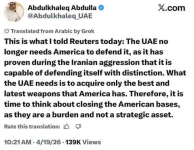
"... closing the American bases, as they are a burden and not a strategic asset." AA #184
If it comes to that, Trump will declare this his deliberate intention, retroactively justifying it on basis of fiscal responsibility, skillful execution of noble conservatism, or ...

"Trump screamed at aides for hours" ti.com #185
OK aides,
It's in the 25th Amendment:
ARTICLE #25: Ratified February 10, 1967
SECTION1. In case of the removal of the President from office or of his death or resignation, the Vice President shall become President. ...
What are you waiting for?
 
Some think U.S. conduct in the Strait of Hormuz is piracy, technically its an act of war. Trump threatens to destroy Iran's power plants. We can't afford upkeep on our own infrastructure. War reparations to Iran after the U.S. destroys what's there would be prohibitively expensive.

And when we (the US) joined the UN in 1945, Congress ratified the UN charter making acts of war illegal unless we are attacked first.
 
"And when we (the US) joined the UN in 1945, Congress ratified the UN charter making acts of war illegal unless we are attacked first." R5 #187
Help us out here R5.

Though the U.N. charter was formulated in the nuclear age, might it have reflected non-nuclear / pre-nuclear realities?

When Putin's Russia began massing Russian military assets along Ukraine's border preparing to invade and conquer, would / should Ukraine have legitimately been deemed the aggressor if it fired the first shots,
to diminish the obvious enemy threat on its border?

Do nuclear weapons change this pre-nuclear standard?
The agreement Obama made with Britain, France, Germany, China, Russia, & Iran regarding Iran's nuclear weapons program was premised on preemption.
Rather than dealing with a nuclear-armed Iran after the fact, attend to it before.
The best time to snuff out a massively destructive wildfire is while it's still on the match. Strangle the baby while it's in the crib !

Can we maintain a viable pretense of international equality, within a global population of nuclear haves, & have-nots?
 
Help us out here R5.

Though the U.N. charter was formulated in the nuclear age, might it have reflected non-nuclear / pre-nuclear realities?

When Putin's Russia began massing Russian military assets along Ukraine's border preparing to invade and conquer, would / should Ukraine have legitimately been deemed the aggressor if it fired the first shots,
to diminish the obvious enemy threat on its border?

Do nuclear weapons change this pre-nuclear standard?
The agreement Obama made with Britain, France, Germany, China, Russia, & Iran regarding Iran's nuclear weapons program was premised on preemption.
Rather than dealing with a nuclear-armed Iran after the fact, attend to it before.
The best time to snuff out a massively destructive wildfire is while it's still on the match. Strangle the baby while it's in the crib !

Can we maintain a viable pretense of international equality, within a global population of nuclear haves, & have-nots?

The theory of the UN charter was to make war obsolete by confining conflict to the International Court at the Hague.
I believe that was in order to take the nuclear reality into account, where war should no longer be viable since the nuclear destruction would prevent war from ever having an actual winner any more.

I believe that the problem that prevented the UN from working as intended, was the way the Security Counsel was given dictatorial power, and there was no written constitution, Rule of Law, or any judiciary. For example, the US refusing to accept the international court.

So how did this lopsided condition where the US got to dictate to ban international rule of law happen?
It was nuclear preemption.
The US shared its Security Counsil dictatorship with other nuclear powers, and dictated against judicial justice by preventing others from obtaining nuclear equality.

With Iran, as much as I dislike Islam, they actually take the high road by supporting forces of liberation, like Hamas, Hezbollah, and Houthis.
So I agree, international equality likely seems to require nuclear equality as well?
 
"... international equality likely seems to require nuclear equality as well?" R5 #189
OK
In that case I may be prepared to advocate for international inequality.

Perhaps I'm simply self-deluded on this point, but I suspect there was a metaphorical global tip of the hat to equality, BUT !
they wink-&-nodded to U.S. nuclear dominance because:
a) at the inception of the nuclear age we could have wiped the Soviet Union out, left a smoldering crater where the Kremlin had been, BUT !!
b) we didn't. And therefore
c) that could be interpreted as restraint, and thus the U.S. could be trusted.

Dandy.
Under Truman perhaps.

Different story
different millennium
different president with Trump.
 
OK
In that case I may be prepared to advocate for international inequality.

Perhaps I'm simply self-deluded on this point, but I suspect there was a metaphorical global tip of the hat to equality, BUT !
they wink-&-nodded to U.S. nuclear dominance because:
a) at the inception of the nuclear age we could have wiped the Soviet Union out, left a smoldering crater where the Kremlin had been, BUT !!
b) we didn't. And therefore
c) that could be interpreted as restraint, and thus the U.S. could be trusted.

Dandy.
Under Truman perhaps.

Different story
different millennium
different president with Trump.

I am not sure I would give the US credit for NOT nuking the Kremlin.
Russia had a nuclear program going back to 1930, and we did not really know if they had nukes yet or not in 1944?
Turns out they were close, and set off test nukes in 1949.
 
"I am not sure I would give the US credit for NOT nuking the Kremlin.
Russia had a nuclear program going back to 1930, and we did not really know if they had nukes yet or not in 1944?
Turns out they were close, and set off test nukes in 1949." R5 #191
BUT !
Whatever they tested may not have fit into a bomb casing that would protect the contents until detonation on target.
Either way, we dropped TWO nukes on Japan:
Hiroshima on August 6, 1945,
Nagasaki on August 9, 1945

Presumably therefore we could have come up with a few more between then and 1948.

The Kremlin is still there.

The implication may be plain old outright wrong.
Right or wrong, the appearance is for that ~3 year period of time, over 1,000 days, the U.S. had supreme nuclear weapons dominance in the solar system.
And after Japan's unconditional surrender, there's been no nuke used in military combat (that I can recall).

S2 makes a superb point.
Those 3 nuke war free years do not prove the U.S. can be trusted.
More likely what it demonstrates is that the leaders at that time were trusted, without well publicized cataclysm.

The Trump administration changes things monumentally. Because he can't be trusted, we can't be trusted.
 
BUT !
Whatever they tested may not have fit into a bomb casing that would protect the contents until detonation on target.
Either way, we dropped TWO nukes on Japan:
Hiroshima on August 6, 1945,
Nagasaki on August 9, 1945

Presumably therefore we could have come up with a few more between then and 1948.

The Kremlin is still there.

The implication may be plain old outright wrong.
Right or wrong, the appearance is for that ~3 year period of time, over 1,000 days, the U.S. had supreme nuclear weapons dominance in the solar system.
And after Japan's unconditional surrender, there's been no nuke used in military combat (that I can recall).

S2 makes a superb point.
Those 3 nuke war free years do not prove the U.S. can be trusted.
More likely what it demonstrates is that the leaders at that time were trusted, without well publicized cataclysm.

The Trump administration changes things monumentally. Because he can't be trusted, we can't be trusted.

The 2 nukes we dropped on Japan were Fat Man and Little Boy.
Little Boy was extremely simple and reliable, with a hollow cylinder of Uranium that had a rod of Uranium fired into its void, to reach critical mass.
There was no question of the fissile ability of uranium or the critical mass detonating.
But Fat Man was much more efficient if it worked, but far less sure.
Being plutonium instead of uranium, it was not clear what level of enrichment was necessary?
Then there was the fact it contained far less fissile material, and was relying on an outer explosive shell concentrating the plutonium into a denser and therefore more explosive mass. The trick was to get the whole shell to implode all at once.
 
"The 2 nukes we dropped on Japan were Fat Man and Little Boy." R5 #193
In 1973 I visited the small museum at West Point / Highlands, NY and saw a replica of one of the nukes dropped on Japan.

The hypocrisy thing is deeply troubling to me R5. ‘To thine own self be true’ Polonius, a Councillor to the King, Claudius, in Act 1 Scene 3 of Shakespeare’s, Hamlet

In our nation we memorialize in song as "the land of the free, and the home of the brave" we reportedly have the highest per capita incarceration rate in the Western world.
That's substantially due to Drug War, a martial usurpation of the Creator endowed, Constitutionally enumerated, unalienable* right of Liberty.
Drug War punishes the exercise of an unalienable right as a crime, a vivid, conspicuous contradiction.

We lie to ourselves about ourselves. We know it. They know it.
Iran peacefully agreed to U.S. terms on the nuclear issue (Obama), the Trump administration unilaterally withdrew from the agreement, and has substituted multiple lethal wars instead.
Is it any wonder that Trump negotiate his preferences at the moment, opening the Strait of Hormuz, is difficult?
Trump's 2nd War on Iran reportedly killed Iran's leader, and now Trump flounders about reaching agreement with Iranian leadership (if any).

Last Update April 21, 2026, 2:55 AM EDT

US seizes Iranian ship after opening fire; Pakistan talks in doubt​

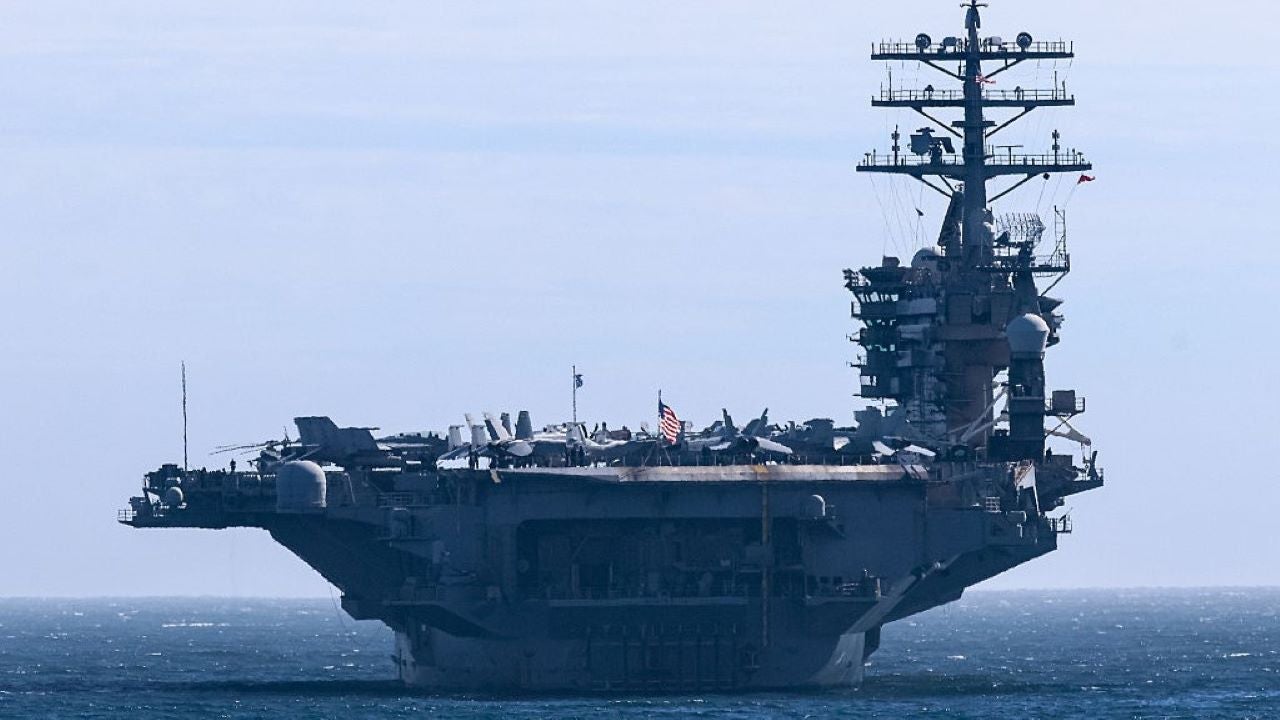
A U.S. Navy destroyer fired on an Iran-flagged tanker vessel in the Strait of Hormuz on Monday as President Donald Trump's blockade on Iranian ports continues to be enforced. Plans for peace talks in Pakistan appear uncertain amid the tensions.


* un·al·ien·a·ble (ŭn-ālyə-nə-bəl, -ālē-ə-)
adj.
Not to be separated, given away, or taken away; inalienable
The American Heritage® Dictionary of the English Language, Fifth Edition copyright ©2022 by HarperCollins Publishers. All rights reserved.
 
Back
Top